
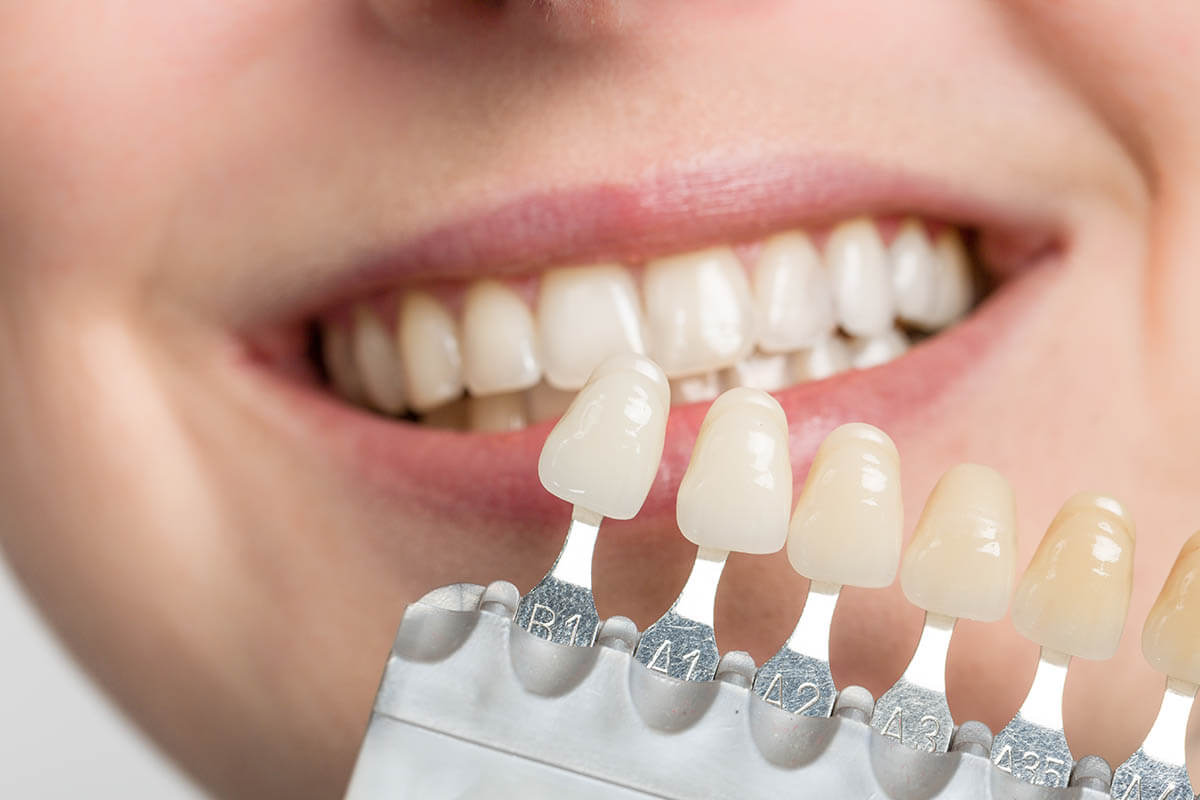
If you’re comparing dental implants vs. veneers, it’s important to understand that they are not the same treatment. Veneers are used to improve the appearance of existing teeth, while dental implants are designed to replace missing teeth.
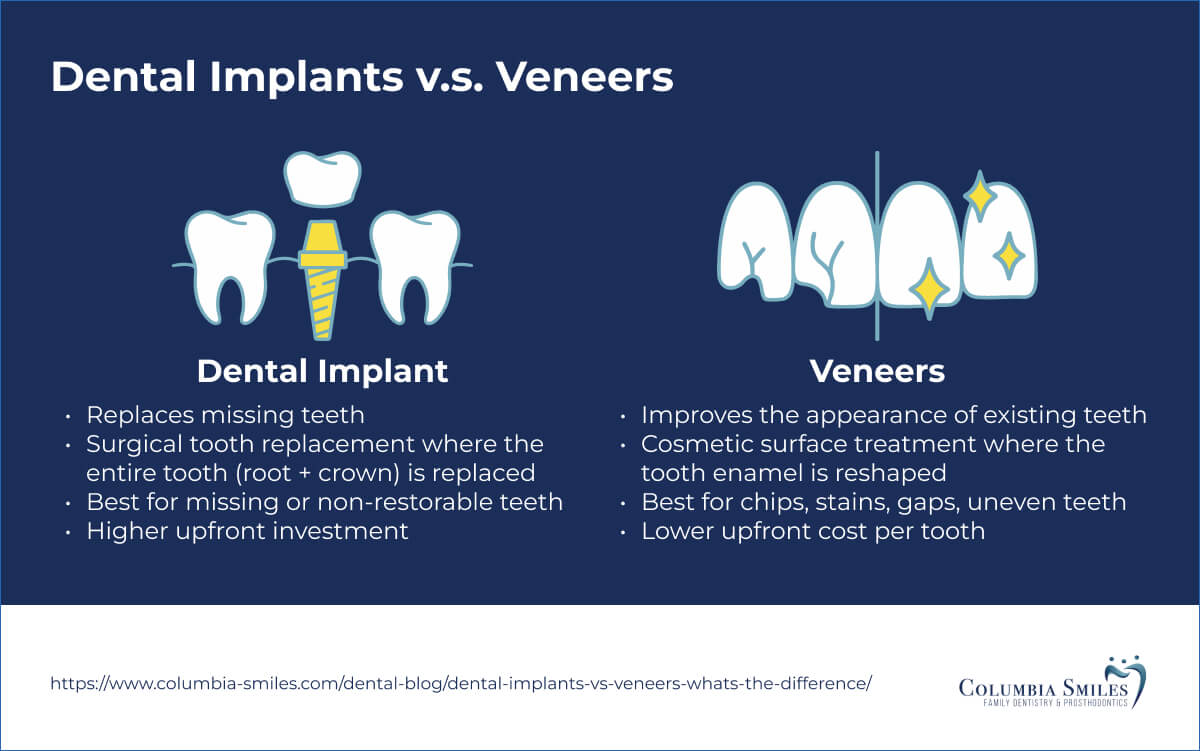
When are veneers or implants used? Veneers are thin coverings placed on the front of natural teeth for cosmetic improvement, while dental implants replace the entire tooth—including the root—when a tooth is missing or cannot be saved.
If you’re unsure which option is right for your smile, schedule a consultation with Columbia Smiles to get a personalized recommendation based on your needs.
Quick comparison of dental implants & veneers
| Dental Veneers | Dental Implants | |
|---|---|---|
| Main purpose | Improve appearance of existing teeth | Replace missing teeth |
| Best for | Chips, stains, gaps, uneven teeth | Missing or non-restorable teeth |
| Requires an existing tooth? | Yes | No |
| Procedure type | Cosmetic surface treatment | Surgical tooth replacement |
| Tooth structure affected | Enamel is reshaped | Entire tooth (root + crown) replaced |
| Timeline | Typically faster | Longer due to healing |
| Longevity | Long-lasting, may need replacement | Designed for long-term use |
| Cost | Lower upfront per tooth | Higher upfront investment |
| Bone support | Does not affect jawbone | Helps maintain jawbone |
| Best next step | Cosmetic consultation | Implant consultation |
What are dental veneers?
Dental veneers are thin, custom-made shells placed on the front of natural teeth to improve their appearance. They are commonly used in cosmetic dentistry to enhance the shape, color, and symmetry of a smile. Veneers may help with:
- Discoloration that doesn’t respond to whitening
- Minor chips or cracks
- Small gaps between teeth
- Slightly misshapen or uneven teeth
- Worn enamel or cosmetic imperfections
Because veneers are applied to existing teeth, they are not used to replace missing teeth.
What are dental implants?
Dental implants are a long-term solution for replacing missing teeth. They consist of a small titanium post placed into the jawbone, which acts as an artificial tooth root, along with an abutment and a custom crown. Dental implants may help:
- Replace one or more missing teeth
- Restore chewing function
- Support crowns, bridges, or dentures
- Preserve jawbone structure after tooth loss
- Provide a natural-looking replacement
Unlike veneers, implants do not rely on existing teeth, they replace the entire tooth structure, restoring dental function and appearance.
Are veneers and dental implants the same thing?
No, veneers and dental implants are not the same thing. Veneers are placed on the front surface of natural teeth to improve appearance, which means they require an existing, healthy tooth structure. Dental implants, on the other hand, are used to replace missing teeth by restoring both the root and the visible portion of the tooth.
If you’ve been wondering if veneers are dental implants or the difference between dental implants and veneers, the key distinction is simple: veneers enhance what’s already there, while implants replace what’s missing.
Dental implants vs. veneers: Key differences to consider
Tooth replacement vs. cosmetic enhancement
The biggest difference between veneers vs dental implants is purpose. Implants replace missing teeth, while veneers enhance the appearance of existing teeth.
Procedure and treatment timeline
Veneers are typically completed in fewer visits and do not require surgery. Dental implants involve a surgical procedure and healing time before the final restoration is placed.
Cost and insurance considerations
When comparing how much dental implants vs veneers cost, veneers usually have a lower upfront cost per tooth. Implants tend to cost more initially due to surgical placement and multiple components. Final costs vary based on your specific needs.
Longevity and maintenance
Both veneers and implants require proper oral hygiene and regular dental visits. Veneers may need replacement over time, while implants are designed as a long-term solution but still depend on healthy gums and maintenance.
Oral health and jawbone support
Dental implants replace the tooth root and help maintain jawbone support. Veneers do not affect the jawbone because they are placed on existing teeth.
Candidacy
Your dentist can help you decide which option is right for you. They will look at:
- Whether the tooth is present or missing
- Your overall oral health
- Gum and bone condition
- Cosmetic goals
- Budget and timeline
When are veneers the better option?
Veneers may be the better choice if your primary goal is to improve the appearance of your smile rather than replace missing teeth. You may be a good candidate for veneers if you:
- Have healthy natural teeth
- Want to improve tooth color, shape, or symmetry
- Have minor chips, gaps, or cosmetic imperfections
- Do not need to replace a missing tooth
- Prefer a less invasive treatment option
Because veneers are part of a broader smile enhancement approach, they are often recommended as part of a personalized plan within cosmetic dentistry.
When are dental implants the better option?
Dental implants are typically the better option when the goal is to replace missing teeth or restore function, not just improve appearance. You may be a good candidate for dental implants if you:
- Are missing one or more teeth
- Have a tooth that cannot be restored
- Want a fixed, long-term replacement option
- Need to restore chewing function
- Want to support long-term jawbone health
Because implant treatment often involves multiple steps and careful planning, starting with general dentistry can help determine whether implants are appropriate and whether any preparatory care is needed. You can also explore more details about dental implants to understand the full process.
Can you get veneers and dental implants together?
Some patients benefit from combining both veneers and dental implants as part of a comprehensive smile restoration plan.
For example:
- A dental implant may be used to replace a missing tooth
- Veneers can enhance the appearance of surrounding natural teeth
- Teeth whitening may be recommended before veneers to ensure consistent color
Sometimes, more complex treatments like full mouth reconstruction or other restorative options like crowns and bridges may be recommended.
Dental implants vs. veneers cost: What impacts the price?
The cost of dental implants vs veneers depends on several factors.
Veneer cost may depend on:
- Number of teeth treated
- Material used (porcelain vs composite)
- Cosmetic complexity
Implant cost may depend on:
- Number of missing teeth
- Need for extraction or bone grafting
- Implant components and restoration
- Imaging and treatment planning
The best way to compare the cost of veneers vs. dental implants is through a personalized evaluation. Schedule a consultation with Columbia Smiles to get an accurate treatment plan.
Which is better: Veneers or dental implants?
Neither option is universally better as they serve different purposes.
Veneers may be right if:
- Your tooth is still present
- Your main concern is cosmetic
- You want to improve appearance
Dental implants may be right if:
- A tooth is missing
- A tooth cannot be saved
- You need functional tooth replacement
Questions to ask your dentist before choosing veneers or implants
During your appointment, ask your dentist some questions about your situation and the treatment they recommend. Here are some to help you get started:
- Is my tooth healthy enough for a veneer?
- Am I missing a tooth or at risk of losing one?
- Do I have enough bone for an implant?
- Do I need treatment for gum disease first?
- Which option supports my bite and function best?
- What will the timeline look like?
- What maintenance is required?
- What are the cost considerations?
- Could I benefit from both treatments?
FAQs about dental implants vs. veneers
Sometimes minor irritation resolves, but persistent nerve pain usually means something is wrong and needs dental treatment. Pain that disappears can also mean the nerve has died, which still requires care to prevent infection.
Mild irritation can resolve in a day or two. A dentist should evaluate pain lasting more than 48 hours.
Ibuprofen is generally most effective because it reduces both pain and inflammation. Always follow dosage instructions.
To sleep more comfortably with tooth nerve pain, try elevating the head, taking ibuprofen before bed, and using a cold compress. If pain consistently wakes you up, see a dentist.
To sleep more comfortably with tooth nerve pain, try elevating the head, taking ibuprofen before bed, and using a cold compress. If pain consistently wakes you up, see a dentist.
To sleep more comfortably with tooth nerve pain, try elevating the head, taking ibuprofen before bed, and using a cold compress. If pain consistently wakes you up, see a dentist.
To sleep more comfortably with tooth nerve pain, try elevating the head, taking ibuprofen before bed, and using a cold compress. If pain consistently wakes you up, see a dentist.
Talk to Columbia Smiles about veneers, implants, and smile restoration
At Columbia Smiles, Dr. Michael Hsu and his team take a personalized approach to smile restoration, helping patients choose between veneers, dental implants, or a combination of treatments based on their long-term goals.
Schedule a consultation with Columbia Smiles in Columbia, MD, to explore your options and create a personalized treatment plan.